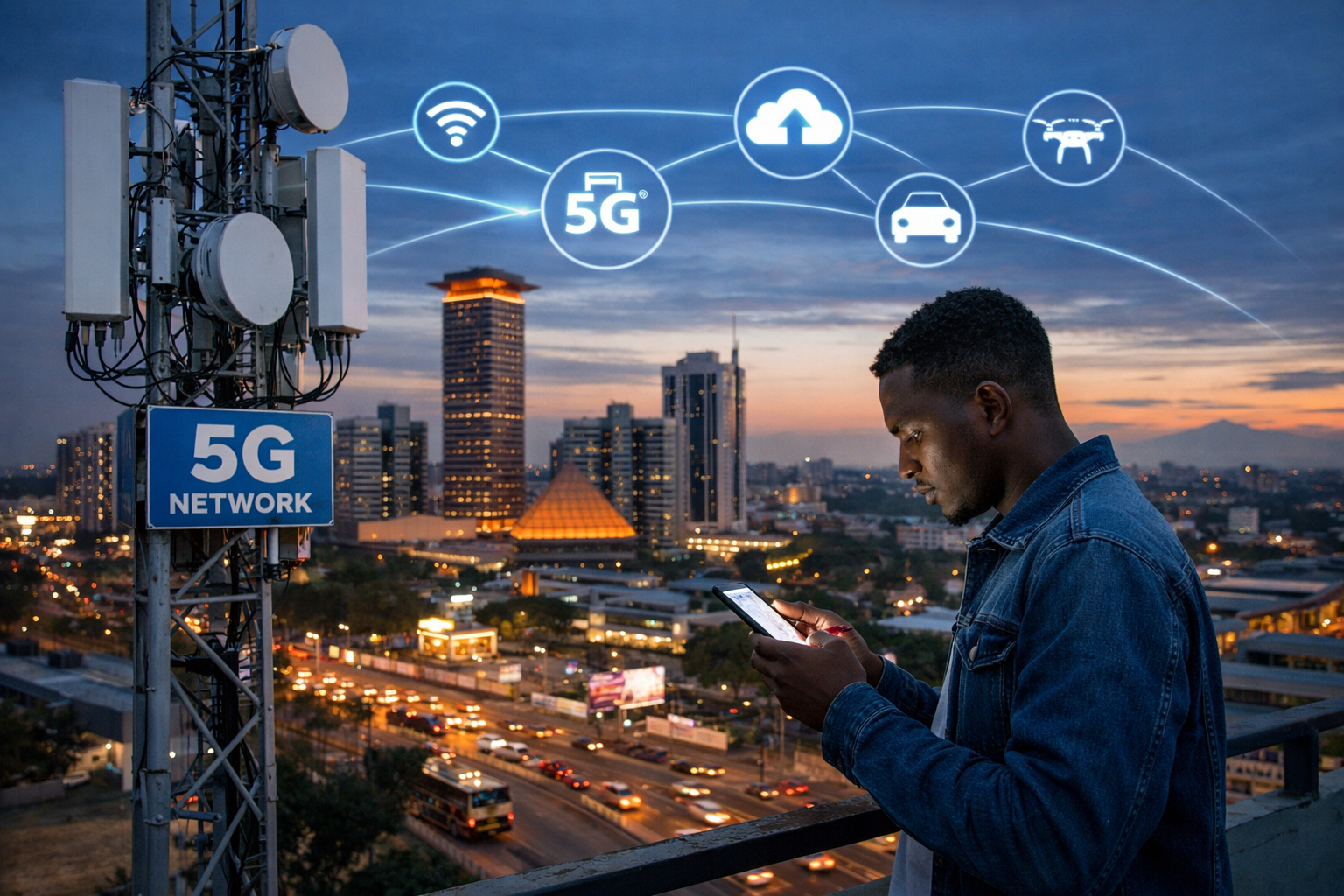
Discover how 5G is transforming tech in Kenya, boosting connectivity, innovation, and business, and learn when it will truly make a difference.
Introduction — Kenyans Are Getting a Faster Digital Future
Kenya’s telecommunications landscape is quickly evolving, and at the center of this change is 5G — the fifth generation of mobile network technology. First launched commercially by Safaricom in October 2022, 5G brings faster speeds, lower latency, and the capacity to connect many more devices simultaneously than older networks like 4G.
But what real benefits does 5G bring to Kenya — and when will it truly start to matter to ordinary users, businesses, and innovators?
What Is 5G ?
5G is the next generation of mobile networks after 4G. It’s designed not just for faster browsing and downloads, but to support advanced technologies like Internet of Things (IoT) devices, smart systems, cloud computing, and real-time applications. Higher performance and improved efficiency empower new user experiences and connects new industries. Its key advantages include:
- Much higher data speeds
- Lower latency (faster response times)
- Ability to connect millions of devices per square kilometer
These improvements are foundational for tech evolution — especially in areas like AI, automation, and smart infrastructure.
5G Is Expanding Rapidly in Kenya
Since its commercial introduction:
- Safaricom’s 5G network now covers all 47 counties and has over 1,000 active sites serving cities, towns and businesses.
- Adoption is growing fast, with over a million 5G users as more Kenyans buy 5G-ready devices.
- Competitors like Airtel and Equitel have also rolled out 5G in many locations, boosting access and competition.
Even with this expansion, 4G remains the dominant network overall, though 5G subscriptions are rising steadily.
How 5G Will Transform Key Tech Areas in Kenya
a) Faster Internet for Users & Businesses
With 5G, internet speeds can be many times faster than 4G, enabling smoother streaming, quicker uploads/downloads, and better performance for remote work and education. This matters especially as online services and cloud platforms become central to business operations.
b) Boosting Innovation (IoT & Smart Tech)
Unlike older networks, 5G can handle hundreds of thousands of connected devices in a small area — making it ideal for:
- Smart city systems (traffic management, public safety)
- Agritech sensors for crop and climate monitoring
- Industrial automation and robotics
- Remote healthcare and telemedicine in underserved regions
These capabilities can significantly accelerate tech innovation across Kenya’s economy.
c) Enterprise & Industry Growth
Companies can use 5G to support real-time data analytics, cloud computing, and advanced connected services. Industries like logistics, manufacturing, and finance could scale faster as connectivity becomes more reliable and powerful.
When Will 5G Truly Matter for Kenya?
Right now, 5G is most noticeable for urban users and early adopters with compatible devices. However, several trends point to a broader impact soon:
1. More Accessible Devices
As more affordable 5G-enabled smartphones and routers hit the market, adoption will spread beyond high-income urban users.
2. Lower Data Costs
Telcos are gradually introducing tailored 5G data bundles, reducing barriers for both consumers and businesses.
3. Enterprise Use Across Sectors
5G matters most where real-time processing and ultra-fast connectivity are essential — like in hospitals, smart logistics, cloud gaming, and virtual learning. As these sectors integrate 5G, its real value will be widely felt.
Frequently Asked Questions (FAQs)
1. Is 5G available in Kenya right now?
Yes. 5G is already available in Kenya, mainly in major towns and cities. Safaricom launched commercial 5G services in 2022 and continues to expand coverage across counties.
2. Which mobile networks offer 5G in Kenya?
Safaricom is currently the leading provider of 5G in Kenya. Other operators, such as Airtel, are gradually rolling out 5G services in selected areas.
3. Do I need a special phone to use 5G in Kenya?
Yes. You need a 5G-enabled smartphone or router to access 5G networks. Devices that only support 4G or 3G cannot connect to 5G.
4. Is 5G faster than 4G in Kenya?
In ideal conditions, 5G is significantly faster than 4G. However, real-world speeds depend on location, network congestion, and device quality. In some areas, 5G may currently feel similar to strong 4G.
5. Will 5G reduce internet costs in Kenya?
Not immediately. While 5G can be more efficient, data costs are influenced by pricing strategies, competition, and infrastructure investment. Over time, increased adoption may lead to more affordable bundles.
6. How will 5G impact businesses in Kenya?
5G can support faster cloud services, real-time data processing, IoT devices, and automation. This is especially important for sectors like fintech, logistics, healthcare, manufacturing, and agritech.
7. Does 5G work in rural areas of Kenya?
5G coverage is currently stronger in urban and high-population areas. Rural expansion will take time due to infrastructure costs, but future rollouts are expected as demand and investment increase.
8. Is 5G safe to use?
Yes. 5G technology operates within international safety standards set by global health and telecommunications organizations. There is no scientific evidence showing that 5G is harmful when deployed correctly.
9. When will 5G really matter for everyday Kenyans?
5G will matter most when 5G devices become cheaper, coverage becomes wider, and businesses start building services that rely on ultra-fast, low-latency connectivity. This is likely over the next few years.
10. Should I switch to 5G now or wait?
If you live in a covered area and already own a 5G-enabled device, switching can offer better performance. Otherwise, waiting may be more practical until coverage and affordability improve.
Conclusion
In Kenya, 5G isn’t just a faster version of mobile internet — it’s a technology platform that can power innovation and new industries. Its spread across all counties and rising user base shows the network is becoming mainstream. Once devices are more affordable, data costs fall, and businesses adopt 5G-based systems, Kenya’s digital economy will truly begin to unlock the full potential of 5G.